
The short answer
Twelve volts will not hurt you, and it will not need a trench
Everything after the transformer is extra-low voltage. That single fact decides how the cable is laid, who is allowed to lay it, and how much of a Saturday the job takes.
What extra-low voltage actually means
A transformer sits in a dry place — a porch, a shed, a weatherproof box on the wall — and drops 230 volts down to 12. Everything on the garden side of it runs at that lower voltage, and the regulations treat it as a different animal from a mains circuit.
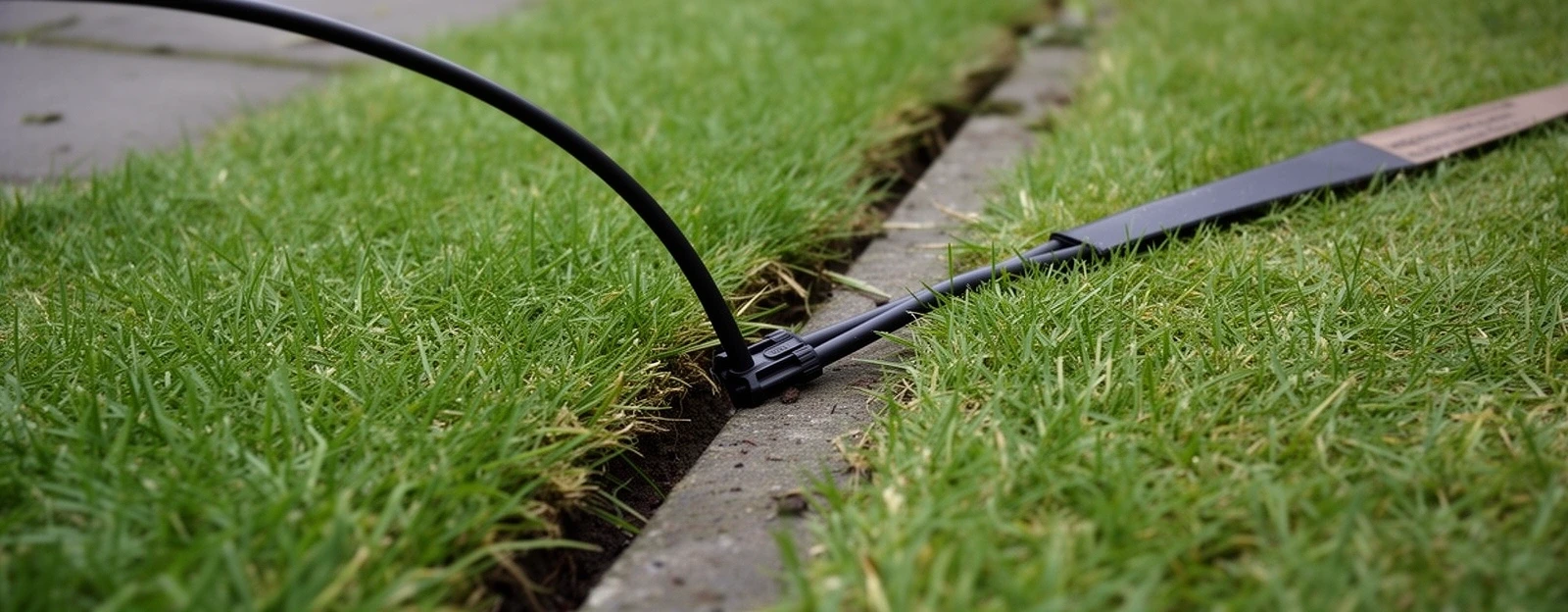
In practice that means the cable can be pegged into a shallow slit in the turf instead of buried at 450 mm in a sand-filled trench with warning tape over it. It means a spade through the cable trips the transformer rather than you. And it means no Part P notification for the garden side, because Part P covers fixed mains wiring, not the low-voltage run beyond the transformer.
The catch, and there is always one, is that low voltage means high current for the same wattage. Thirty watts at 230 volts draws a tenth of an amp. The same thirty watts at 12 volts draws two and a half. Current is what heats cable and what drops voltage along a run, which is why the table below matters more here than it would on a mains circuit.
Numbers worth carrying
- Voltage at the transformer
- 12 V a.c., sometimes 11.5 under load
- Usable at the far fitting
- 10.5 V and up — below that the LED dims visibly
- Current per 30 W
- 2.5 A
- Burial depth needed
- None. A slit under the turf is enough
- Part P notification
- Not for the garden side
What arrives at the far end
Measured on our own bench with a 30 watt load — roughly ten path lanterns — at the end of a single run. The bar shows how much of the twelve volts survives the journey.
| Run length | 2 × 1.5 mm² | 2 × 2.5 mm² |
|---|---|---|
| 10 m | ||
| 20 m | ||
| 30 m | ||
| 40 m |
Below about 10.5 volts a warm-white LED goes noticeably yellower and a little dimmer, which is fine at the end of a border and irritating on a front path where the fittings sit next to each other. Two ways round it: step up to 2.5 mm² cable, or split the garden into two runs and feed them from opposite ends of the transformer. We usually suggest the second, because it is cheaper and it halves the damage when something gets cut.
What you do not need
- —A trench. A half-moon edging iron opens a slit, the cable goes in, the turf closes over it. An afternoon, not a weekend.
- —Armoured cable or conduit. Two-core rubber-sheathed is what the system is designed around.
- —A Part P notification for the garden side, and no building control fee with it.
- —An RCD on every fitting. The transformer isolates the garden from the mains already.
- —Us. Most people lay their own. We will tell you where the cable should go and then get out of the way.
What you do need
- +A dry, ventilated spot for the transformer. Inside a shed or porch beats a box on a north wall.
- +An existing outdoor socket, or an electrician to fit one. That part is notifiable and we are not going to pretend otherwise.
- +Connectors that suit being wet. Gel-filled ones, not a chocolate block in a sandwich bag.
- +A metre of slack at each end and a loop at every fitting, so frost heave has somewhere to go.
- +A rough sketch with lengths on it. Ten minutes on paper saves a second cable order.
So which transformer
Add up the watts, add a fifth for headroom, and pick the next box up. The planner does the arithmetic and tells you when the answer is really two smaller runs rather than one big one.