
The bench
Nine out of ten old lanterns are worth saving
The tenth is usually pressed steel from about 1994. This page is the ledger rather than a sales pitch: five real jobs, what was wrong, what we did and what went on the invoice.
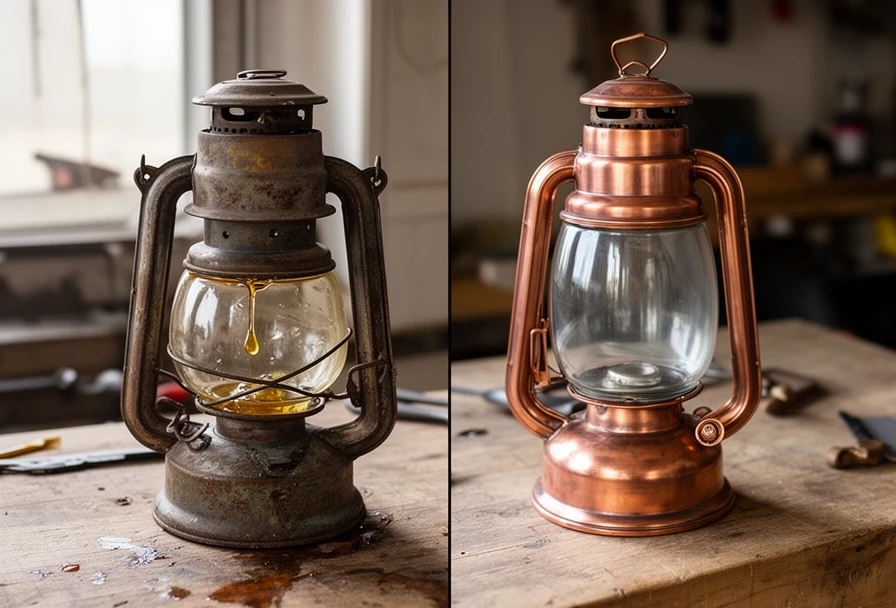
Five off the book
Picked because they cover the range, not because they flatter us — one of them is a job where we sent half the order back.
Copper porch lantern, Victorian, off a house on Unthank Road
Came in green, which was fine, and leaking, which was not. A soldered seam had opened along the back panel and eighty years of rain had got into the holder.
Cleaned back to bright copper on the seam only, re-soldered, new silicone gasket under the glass, 12 volt board in place of the old brass holder. We left the patina everywhere else, because that was the point of keeping it.
Pair of cast-iron gate pillar lamps, 1930s
Rusted through at the base flange, one of them badly enough that the bolt holes had gone. Both had been painted black over rust at least twice.
Shot-blasted, welded plate let into the worst flange, zinc-rich primer, two coats of satin black. New 4 mm glass all round because the originals were cracked and modern glass is cheaper than trying to cut old.
Brass ship’s bulkhead light, unknown maker
Solid. Genuinely nothing wrong with the body at all — somebody had looked after it. It was wired for 230 volts with a cloth flex that had gone hard.
Stripped the flex, new tails, 12 volt board on a machined adaptor so the original cage and glass still fit. The cheapest job we did that year and the one that looks best.
Six copper deck lights out of a terrace in Eaton
Bezels pitted, seals perished, two of them full of water. The owner had been told the whole set needed replacing.
Four were fine after new seals and a re-lamp. Two had corroded past the thread and we said so. Charged for six hours and four sets of parts, not for six lights.
Oak and lead lantern from a churchyard path, Wymondham
The lead came had opened at three joints and the oak crown had rotted where water sat on the end grain. The glass, remarkably, was all original and all intact.
New oak crown cut to the old profile, lead re-soldered joint by joint, every original pane back in. The slowest thing we have done and the only one we have photographed properly.
What we send back
Said plainly so nobody drives across the county with something we cannot help with. If yours is on this list, a photograph by email saves the trip.
- ×Pressed-steel fittings from the nineties. The shell is thinner than the rust on it. Nothing to solder to.
- ×Pot-metal castings. Zinc alloy arms snap and cannot be welded. We have tried, twice.
- ×Sealed LED units. If the board is potted into the body there is nothing to replace when it fails.
- ×Integral mains drivers moulded in. To convert it we would have to cut the body open, and then it is our fault.
- ×Anything with asbestos rope in the base. It turns up in pre-war industrial fittings. We stop and send it back.
What the parts of it cost
| Work | What it involves | Price |
|---|---|---|
| Look at it and tell you | Bring it to the yard, ten minutes, no appointment | Free |
| Rewire to 12 volts | New board, tails and gasket, existing body | from £48 |
| New glass | Cut to the old pane, 4 mm clear or seeded | from £18 a pane |
| Re-solder a seam | Copper or brass, cleaned back locally only | from £35 |
| Polish and lacquer | Back to bright, then sealed — ages differently afterwards | from £40 |
| Powder coat | Cast iron or aluminium, satin black or your colour | from £55 |
Quoted after we have seen the fitting, never from a photograph alone — a photograph cannot show you a seam that has opened or a thread that has gone. Restored fittings carry twelve months on the parts we fitted; we cannot guarantee a body we did not make, and we would not believe anyone who said they could.
Bringing one in
The yard is open on weekdays. Ring first if you are coming any distance and we will make sure somebody is at the bench rather than out on the Thursday run.