Cut to length
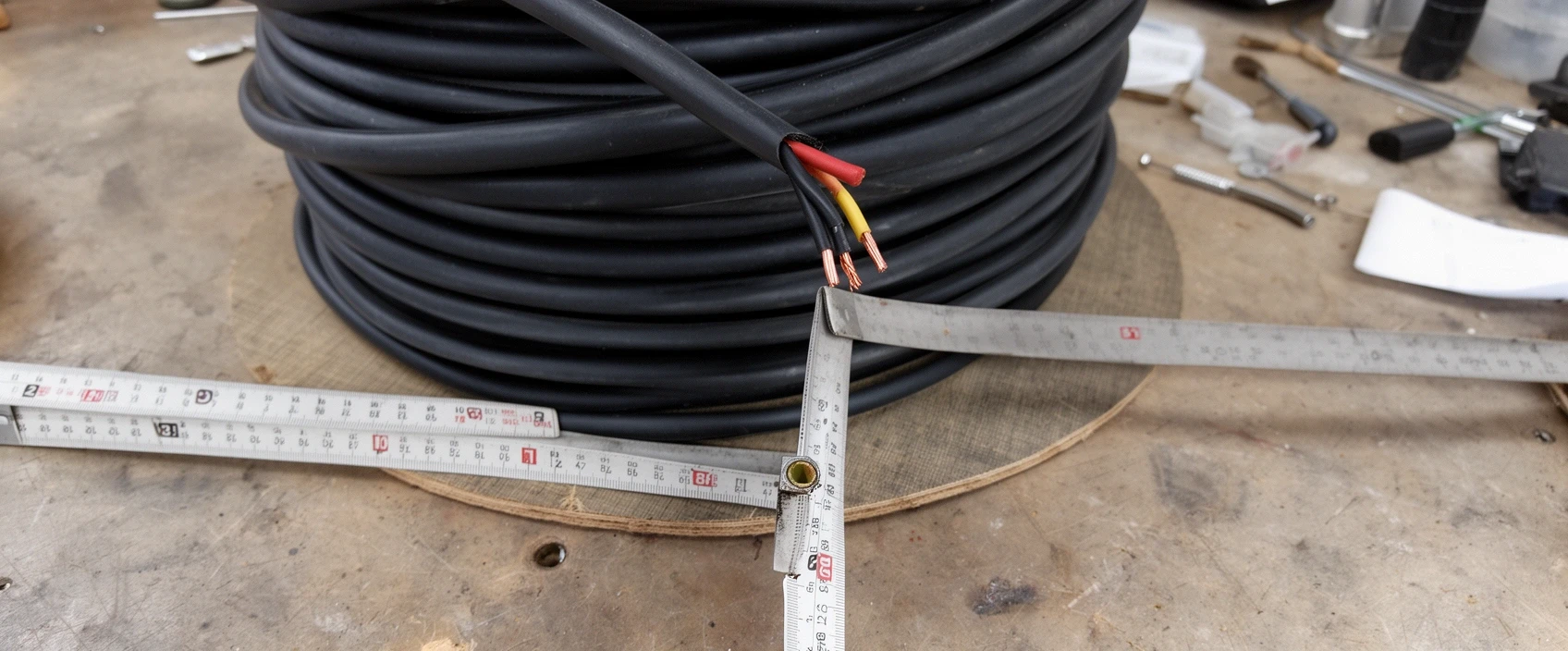
Measured off the drum, not guessed off a chart
Cable is the part people under-order and the part that decides whether the last lantern looks the same as the first. Here is what we stock, how far it will go, and what we join it with.
How far each gauge will carry
Maximum run before the drop gets past one volt, at three common loads. A 15 watt load is about five path lanterns; 60 watts is a garden with spotlights in it.
| Gauge | 15 W | 30 W | 60 W | Price | Availability |
|---|---|---|---|---|---|
| 2 × 1.5 mm² | 33 m | 16 m | 8 m | £2.40 / m | On the shelf, cut while you wait |
| 2 × 2.5 mm² | 54 m | 27 m | 13 m | £3.60 / m | Ordered in, two working days |
These are single runs fed from one end. Feed the same length from the middle instead and you can roughly double the figure, which is almost always cheaper than going up a gauge. Cable does not need to match the fitting: a 1.5 mm² tail off a 2.5 mm² spine is perfectly normal and is how most of our gardens end up wired.
What happens at the bench
We take the longest run on your sketch, not the straight-line distance. Cable goes round beds, not through them.
One at the transformer to reach the socket comfortably, one at the far fitting so it can be moved next spring without a joint.
A steel tape pinned to the bench, not a wheel. Wheels read short on a stiff rubber sheath, by about two per cent.
A tag with the run name and the length. On a two-run garden this saves a phone call in about a year.
Three ways to join it, and what we think of each
All three work on a dry bench. The difference shows up in the third February, which is roughly when Norfolk clay has finished moving.
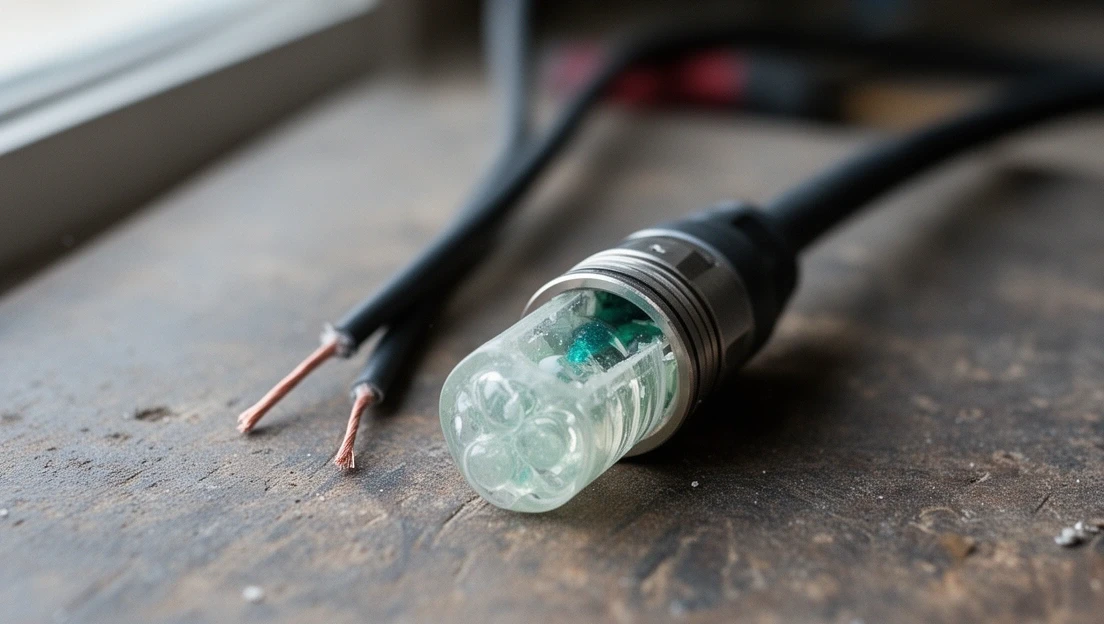
Gel-filled push connector
The gel displaces water and stays soft. No tools, reusable if you are gentle, and it can sit in a puddle without caring. Five in a pack because that is how many a normal garden needs.
Verdict: use theseCrimp and heatshrink
A proper crimp under adhesive-lined heatshrink is as good as anything and neater than a connector body. It needs the right tool and it is permanent — cutting a crimped joint out costs you 80 mm of cable each time.
Verdict: fine, if you own the toolScrew terminal in a box
Brass screws and copper in a damp box corrode into a high-resistance mess, and the first sign is a flickering fitting forty metres away. If it has to be a box, it wants a gland and it wants to be off the ground.
Verdict: indoors onlySix things we keep being called out to
Not a scolding — every one of these is something we have done ourselves at some point.
- 01Chocolate block in a food bag. It fills with water by the second winter. Every time.
- 02Cable pulled tight between pegs. Frost lifts turf. A taut run finds its weakest joint and opens it.
- 03A single run fed from one end. The far fitting is always the dim one. Feed from the middle and the drop halves.
- 04Joints buried without a marker. Put the joint where you can find it — beside a post, under a stone, on the plan.
- 05Undersized cable to save nine pounds. Thirty metres on 1.5 with a full load is visibly yellow at the end.
- 06Mains cable used because it was in the shed. It works, but nothing about the sheath, the colour code or the connectors will match the next person to touch it.
Ordering it
Put the metres in the box on the shop and it comes cut, tagged and coiled. If you are unsure of the length, send the sketch instead — we would rather work it out once than post you a second drum.
Offcuts under two metres go in a box by the door and are free to anyone who asks. There is usually enough in there for a spur to one extra spotlight.